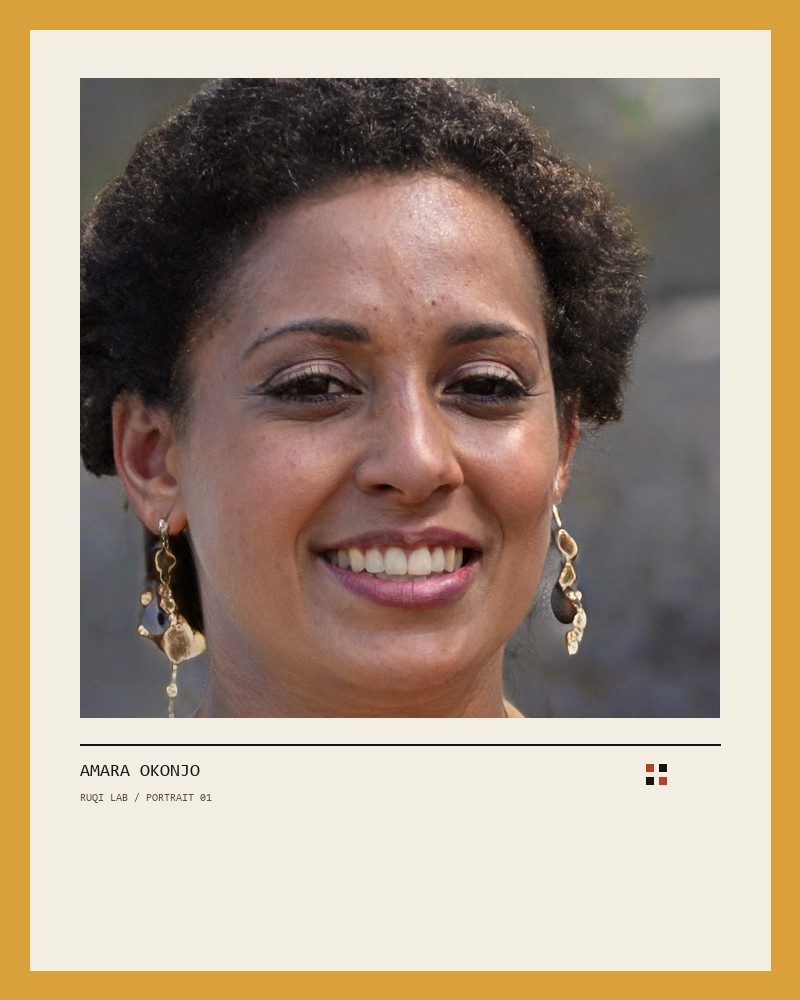
Principal Investigator
Amara Okonjo
Principal Investigator & Co-Founder
she/her · at Ruqi since 2019
“A quantum computer is not impressive because it is strange. It is impressive if it changes what a nurse, a grid operator, or a student can do.”
Amara founded Ruqi Lab in 2019 with a stubborn premise: fault-tolerant quantum computing is too important to become a private moat. She leads the lab's work on error-corrected architectures and the simulation of materials that matter for the energy transition.
She grew up between Enugu and Winnipeg, the daughter of a pharmacologist and a secondary-school physics teacher. A summer spent repairing spectrophotometers convinced her that the most interesting physics happens when theory has to survive contact with a cold, noisy machine. She has spent two decades building superconducting processors, control electronics, and the unglamorous calibration software that makes them work.
At Ruqi she is responsible for research direction, scientific integrity, and the lab's public-benefit test: every program must name who benefits, how the results will be published, and what happens if the technology succeeds. She still takes a shift on the dilution refrigerator every month.
Working on
Fault tolerance · Quantum simulation · Research governance
Off the clock
Hosts a Sunday-night jazz show on community radio and keeps a sourdough starter named Decoherence.
Ask me about
surface codes, lab governance, superconducting hardware, sourdough.
Questions in the drawer
- How do we design a modular quantum computer whose failure modes are boring, observable, and recoverable?
- Which materials problems could a fault-tolerant machine actually answer first — and who needs those answers?
- What governance turns a research result into a public asset rather than a patent?
Selected work
2026
2025
2026
2024
Open to collaborations
Work with Amara
Good questions make better neighbours.
We answer email from students, journalists, public servants, and anyone who is trying to understand what quantum technology can actually do.